Financial markets have changed more in the last decade than in the previous hundred years. Cryptocurrency and decentralized finance (DeFi) markets now operate 24/7, move at extreme speed, and react instantly to global events. In this environment, traders face a critical question: should trading decisions rely on human judgment or artificial intelligence?
The comparison of AI Trading vs Human Traders is no longer theoretical. It is a practical discussion that affects profitability, risk management, and long-term sustainability in crypto and perpetual futures markets. Both approaches have strengths, but their differences become very clear in fast, volatile, always-on markets.
Key Highlights:
- AI trading excels in speed and consistency, executing trades instantly 24/7 without emotions or fatigue.
- Human traders provide strategic insight, interpreting market trends and adjusting strategies based on experience and context.
- AI improves risk management by consistently enforcing stop losses, leverage limits, and position sizing rules.
- A hybrid approach, combining human strategy with AI execution, leverages the strengths of both for better trading outcomes.
- 24/7 crypto markets favor automation, as continuous monitoring and real-time response make AI trading more effective in volatile conditions.
What Is AI Trading?
AI trading uses algorithms and predefined rules to analyze markets and execute trades automatically. These systems do not rely on feelings or intuition. They operate entirely on logic and data.
In DeFi environments, AI trading often runs through smart contracts. These contracts manage positions, adjust exposure, and execute trades directly on-chain. The result is autonomous trading that operates continuously without manual input.
Understanding Human Traders
Human traders study charts, track market sentiment, follow news, and make decisions based on their understanding of price behavior, and they rely on experience, analysis, and judgment. This method worked well in traditional markets with fixed trading hours.
Human judgment allows flexibility. Traders can adapt when unexpected events occur and change strategies when market conditions shift. This ability still matters, especially when markets respond to regulations, geopolitical events, or macroeconomic changes.
AI Trading vs Human Trading – Key Differences
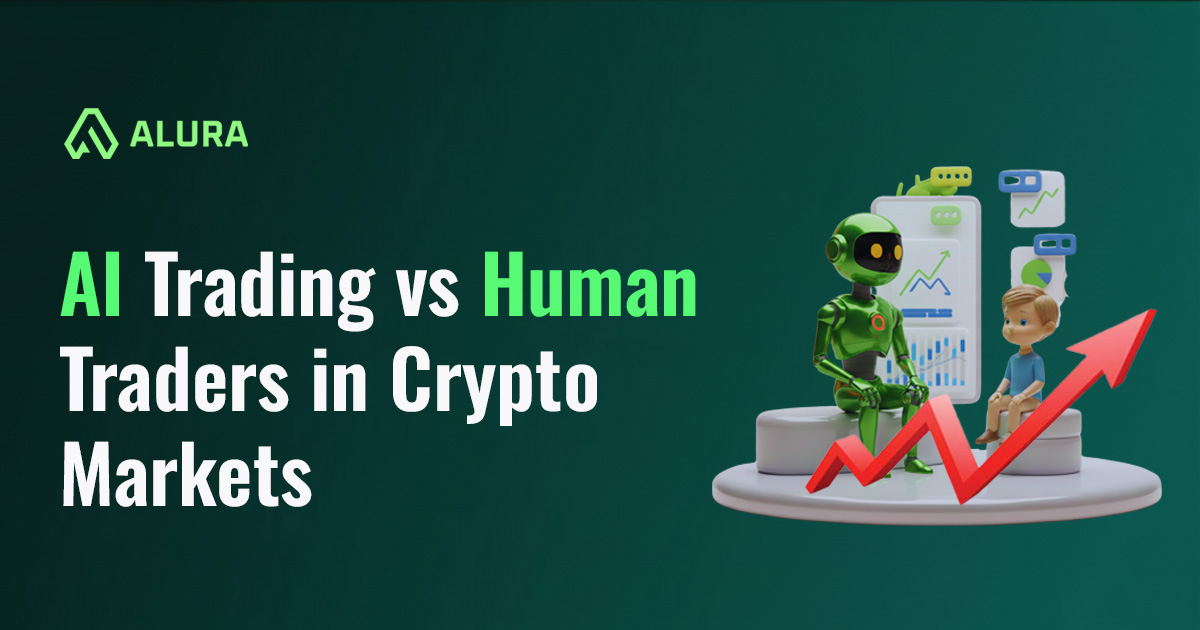
AI trading uses algorithms and automation to execute trades instantly, follow strict rules, and operate 24/7 without emotions or fatigue. Human trading relies on personal judgment and experience but is slower, limited by time, and often influenced by emotions like fear and greed.
| AI Trading | Human Trading |
| Uses algorithms and rule-based systems to execute trades automatically | Uses personal judgment, experience, and manual decisions |
| Executes trades instantly with high speed and precision | Slower due to manual analysis and order placement |
| Operates 24/7 without breaks or downtime | Limited by sleep, fatigue, and working hours |
| Fully emotionless and data-driven | Influenced by fear, greed, stress, and bias |
| Maintains consistent execution and discipline | Performance varies based on mood and psychology |
| Automatically applies risk management rules like stop losses and position limits | May ignore risk rules during emotional situations |
| Monitors and trades multiple markets simultaneously | Can track only a few markets at a time |
| Reduces slippage through optimized order execution | Higher slippage due to delayed or manual execution |
| Works well in volatile and fast-moving crypto markets | Struggles during extreme volatility or rapid price changes |
| Runs on smart contracts or automated systems with transparent logic | Often relies on centralized platforms with limited transparency |
| Scales easily across strategies and portfolios | Scaling requires more time and effort |
| Best for automation, high-frequency trading, and perpetual markets | Best for strategy design, market interpretation, and big-picture thinking |
Why 24/7 Crypto Markets Favor AI Trading?
Crypto markets operate 24/7, making it difficult for human traders to monitor prices continuously or react quickly to sudden volatility.
AI trading systems run nonstop, execute trades instantly, and maintain consistent discipline, making them better suited for always-on crypto markets.
Continuous Market Monitoring
Crypto and perpetual futures markets can change direction in seconds. A sudden liquidation, funding rate spike, or large order can move prices sharply. Human traders cannot watch screens 24/7 without fatigue, but AI systems can.
AI trading bots and autonomous protocols track multiple markets at the same time. They analyze price data, liquidity, and volatility continuously. This constant monitoring ensures that no opportunity or risk goes unnoticed. While a human might miss a midnight breakout, an AI system captures it immediately.
Faster Execution and Real-Time Response
Speed is critical in volatile markets. Even a delay of a few seconds can lead to worse entry prices or higher slippage. Manual trading involves thinking, clicking, and confirming orders, which slows execution.
AI trading removes this delay. It executes trades in milliseconds based on predefined rules. When conditions match the strategy, the system acts instantly. This quick response improves trade accuracy and protects capital during sharp market moves.
No Fatigue or Emotional Stress
Humans naturally lose focus after long hours. Tiredness leads to mistakes, poor judgment, and missed signals. Stress also affects decision-making, especially during sudden price swings.
AI trading systems do not suffer from fatigue or emotional pressure. They follow logic with the same precision at 3 AM as they do at noon. This consistency helps maintain discipline and stable performance over time.
Consistent Risk Management
Risk control becomes harder when traders feel pressure. After a loss, some traders take bigger risks to recover. After a win, others become overconfident. These emotional reactions break discipline and increase losses.
AI trading systems apply strict risk parameters automatically. Stop losses, leverage limits, and position sizing rules stay active at all times. The system never ignores these rules. In 24/7 crypto markets, where volatility can spike suddenly, consistent risk management protects capital and supports long-term survival.
Handling Multiple Markets Simultaneously
Crypto trading involves many assets, perpetual pairs, and liquidity pools. Monitoring all of them manually is nearly impossible. Human traders often focus on only one or two markets at a time.
AI systems can track dozens of markets simultaneously. They compare opportunities, route liquidity efficiently, and allocate capital where conditions look best. This multi-market coverage improves diversification and increases the chance of capturing profitable setups. Automation allows traders to scale their strategies without increasing workload.
Better Fit for Autonomous DeFi Trading
Decentralized finance runs entirely on smart contracts and blockchain infrastructure. AI trading integrates naturally into this environment. Autonomous systems can execute trades on-chain, update positions, and manage liquidity without manual interaction.
This creates a seamless trading process that matches the always-on nature of DeFi markets. Traders gain continuous exposure while maintaining transparency and control.
Combining AI Trading With Human Strategy
The most effective approach to modern crypto and DeFi trading is not choosing between humans or machines, but combining the strengths of both. Human traders excel at strategy design, market interpretation, and understanding broader economic or regulatory trends. They can set goals, adjust risk frameworks, and decide when to change direction based on experience and insight. This high-level thinking provides the foundation that guides any successful trading system.
AI trading then handles execution with speed, precision, and discipline. It monitors markets 24/7, follows predefined rules without emotion, and manages positions consistently across multiple assets. By letting humans focus on strategy while AI manages real-time execution and risk control, traders gain the best of both worlds—smart decision-making backed by reliable automation. This hybrid model represents the future of trading in DeFi and crypto markets.
Conclusion
The comparison between AI trading and human trading clearly shows that modern crypto markets demand speed, discipline, and constant availability. While human traders bring valuable insight and strategic thinking, they struggle to match the consistency and real-time execution required in 24/7, highly volatile markets. AI trading fills this gap by delivering automated execution, strong risk control, and continuous market monitoring, making it a powerful solution for sustainable trading performance.
By combining human strategy with autonomous execution, traders can achieve better outcomes in decentralized markets. Alura is built to support this hybrid approach, enabling deterministic, on-chain trading with transparency and precision. As DeFi and perpetual markets continue to evolve, solutions that blend human intelligence with AI-driven automation will define the future of crypto trading.
Frequently Asked Questions
Is AI Better at Trading Than Humans?
AI excels in speed, consistency, and 24/7 execution, removing emotional errors from trading. Humans, however, still provide strategic insight and context that AI alone cannot interpret.
Is AI Trading Really Profitable?
AI trading can be highly profitable when strategies are well-designed and market conditions are favorable. Its success depends on algorithm quality, risk management, and continuous optimization.
Which AI Trading Services Are Popular for Stock Trading Compared to Human Brokers?
Popular AI trading services include platforms like MetaTrader, Trade Ideas, and Alpaca, which automate execution and analysis. Human brokers focus more on advisory, discretionary trading, and personalized investment strategies.
What Are the Main Differences Between AI Trading Platforms and Human Trading Strategies?
AI platforms follow automated, rule-based execution with speed and discipline, while human strategies rely on judgment, experience, and manual decision-making. AI handles scale and consistency; humans handle adaptability and context.